Between Locations? Smart Commercial Storage Solutions in New Jersey

New Jersey sits at the center of one of the busiest logistics corridors on the East Coast, and businesses relocating within or expanding into the state often need somewhere to put inventory, furniture, and records for weeks or months at a time. Industrial rents in the Port Newark and Elizabeth corridor still run well above the national average, and short-term overflow space is not always easy to lease directly. Commercial storage handled through a moving partner fills that gap without locking a business into a long lease it does not need.
When Businesses Actually Need Commercial Storage
Storage rarely shows up on the original relocation plan, yet it becomes essential more often than expected. A build-out at the new Harrison or Jersey City office runs three weeks past schedule, and the furniture already left the old space. A retailer transitioning between locations in Bergen County needs somewhere to hold fixtures during a permitting delay. A firm consolidating two offices on the Route 1 corridor has 40 percent more furniture than the new floor plan can absorb. In each case, the choice is between paying holdover rent on space no longer usable and moving the contents into a controlled storage environment while decisions get made.
Pro Tip: Ask about commercial storage as part of the initial move quote, not as an afterthought two weeks before the move. Coordinated pricing on transport plus storage is almost always lower than treating them as separate services, and it eliminates the second round of handling that damages furniture.
What “Commercial Storage” Should Actually Include
Not all storage is built for business inventory. Self-storage units serve consumers well but rarely meet the security, climate, and access requirements a company needs for filing cabinets full of client records or a warehouse of demountable workstations. A commercial storage program that supports business relocation should include palletized or vaulted storage, climate control for humidity-sensitive assets, 24-hour monitored facility access, and an inventory system that tracks every asset by barcode or serial number. Retrieval should be scheduled by phone or email rather than requiring a business owner to dig through a unit personally.
Records Storage and What the IRS Actually Requires
Business records take up more space than most companies plan for, and the retention requirements are not optional. The IRS record-keeping guidelines require most business records to be preserved for at least three years, with longer holds for property records, employment tax records, and returns filed with substantial understatements. Many industries add their own requirements on top, from HIPAA for healthcare providers to SEC and FINRA rules for financial services. A storage program that includes fireproof-rated document storage, tracked chain of custody, and secure shredding at end of life protects the company from both compliance failures and the mundane risk of losing a box in a garage somewhere.
Pro Tip: Before boxing records for storage, apply a simple retention label to each carton showing the destroy-by date. Six years from now, the team disposing of expired records will thank the current team that made the sorting decision once instead of forcing it to be made again from scratch.
Furniture, Fixtures, and Technology Between Moves
Systems furniture, IT equipment, and specialty items each need different storage handling. Modular workstations should be broken down and palletized with panels wrapped, and hardware bagged and labeled by station, not thrown into a container to be sorted out later. Servers and network equipment need climate-controlled space and ideally power available for periodic testing. Artwork, executive furniture, and specialty items belong in vaulted or crated storage where they cannot be crushed by a pallet stacked on top. A commercial moving partner that handles decommissioning and liquidation can also make the ongoing decisions about what gets stored, what gets sold, and what gets recycled, which shrinks the storage footprint over time instead of letting it grow.
New Jersey Coverage That Matches the State’s Geography
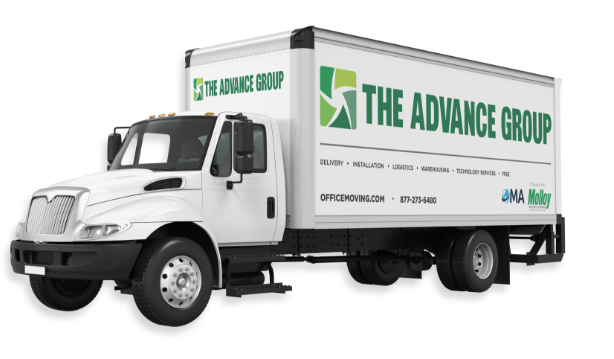
Storage that requires a two-hour round trip for retrieval is not really useful. The Advance Group operates from Harrison, close to the Port Newark and Newark Liberty corridor, with storage that serves clients across the tri-state area. Businesses in Bergen, Hudson, Essex, Union, and Middlesex counties can move furniture and inventory into secure storage and retrieve it on a schedule that matches their real timeline.
Store With a Partner Who Handles the Whole Move
Storage is most useful when it is one step in a coordinated relocation plan, not a separate contract with a separate vendor. The Advance Group provides commercial storage and warehousing as part of full-service business moves across New Jersey, New York, and Florida, coordinating pickup, secure storage, inventory management, and delivery on the schedule that works for the business. Contact The Advance Group to talk through your New Jersey storage and relocation needs.
 877-273-6480